Rooted in ICAO Doc 9835 and EU Directive 2006/23/EC our online test meets the language proficiency standards recognized by all ICAO and EASA member nations. You'll engage in a realistic, work-related English interview, answering pre-recorded questions. We're dedicated to providing a comprehensive testing experience, facilitating your aviation career advancement in Europe and beyond.
The Language Assessment consists of 2 parts performed during a video call
2PARTS
Tailored Approach
We customize each test according to your aviation background. New to flying? Don't worry, we won't ask technical aviation-related questions. Our focus is on your language skills. If it's your first time taking the test, we highly recommend trying a practice test to familiarize yourself with the format and to achieve the best results during the actual Language Proficiency Exam.
During the listening segment, the Language Proficiency Examiner will play a series of questions for you. You should answer using full sentences rather than responding only with “Yes,” “No,” or very brief answers. Remember that the assessment focuses on your English language proficiency, not on whether your opinions or answers are factually correct. Use each question as an opportunity to demonstrate the full range of your language skills.
02
Image questions
You will be shown a selection of two images, each depicting various aviation-related scenarios, randomly chosen from our extensive database. We encourage you to use as many descriptive words as you can to convey what you observe in each image. This exercise is designed to test your language proficiency in the context of aviation themes.
03
ATC transmissions
During the ATC Transmission segment, you'll listen to ATC clearances and ATIS recordings.
The examiner is present throughout the test.
You can use pen and paper to write down clearances.
Direct Interview
Video Call
The assessor will delve into topics from the briefing package and your aviation role. Rest assured, there won't be complex technical questions or knowledge tests.
Our test is purely focused on assessing your language skills.
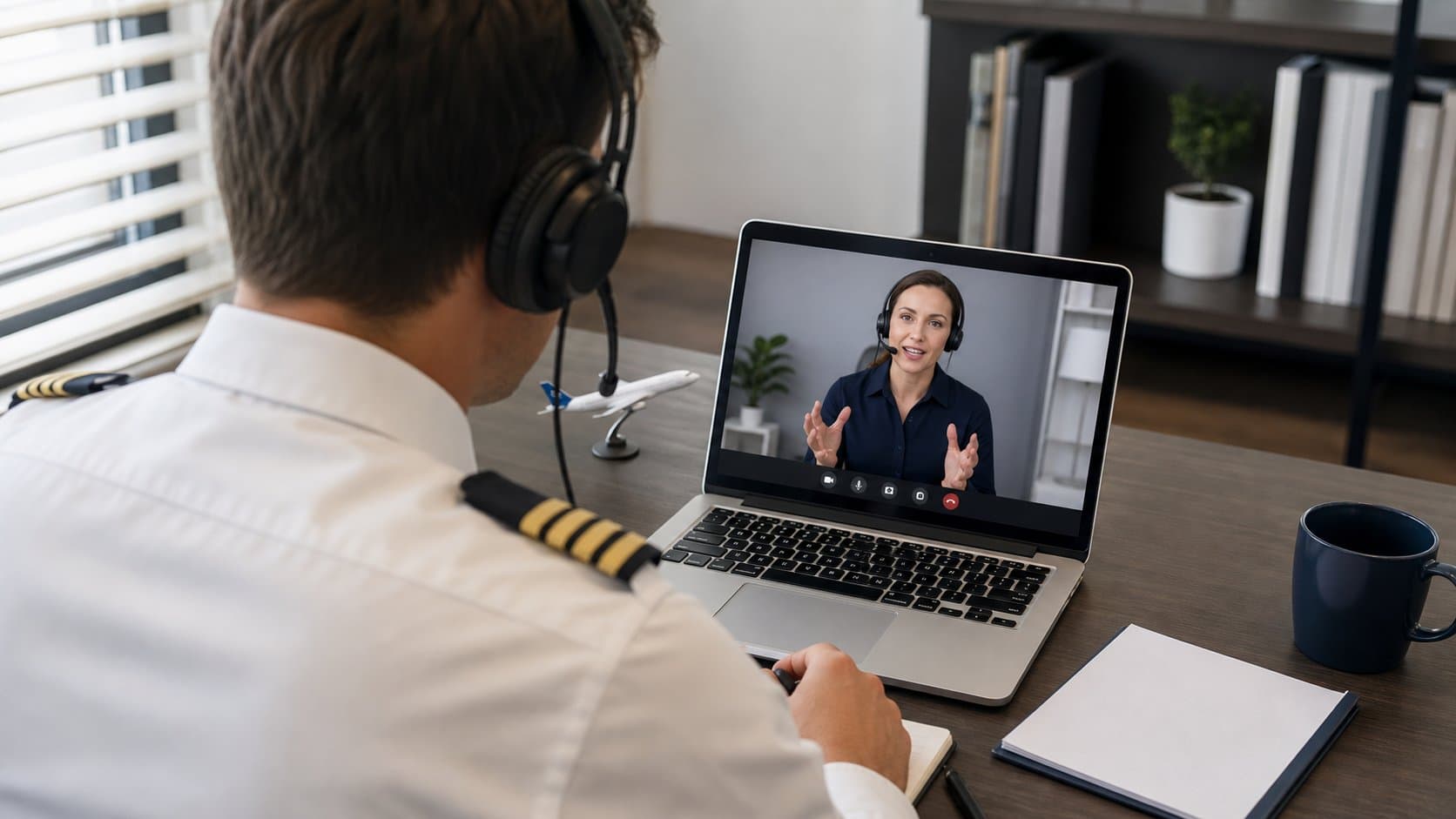
Connection details for the video interview will be provided during the booking process. You can conduct the video call from a mobile device equipped with a front camera, or a computer/laptop with a webcam.
Test results
We assess your answers following ICAO standards for a fair and precise rating. After the test, we'll quickly create your language certificate, your official proof of language skills.
Expect to receive your results via email within 12 hours. Submit your certificate to your licensing authority to have your language proficiency entered on your licence, following its document and submission requirements.
Headphones: For optimal audio quality, particularly when using a mobile device, we recommend using headphones. Avoid wireless earbuds known to have poor microphone quality.
Camera & Lighting: Position yourself approximately 60–90 cm from your webcam in a well-lit room. Make sure your face is clearly visible, avoid strong backlighting, and do not wear face masks or other coverings during the test or video call.
Internet Connection: Ensure you have a stable and reliable internet connection to prevent any disruptions during the test.
Battery Power: If you are using a laptop or mobile device, ensure it is fully charged or connected to a power source to prevent unexpected shutdowns during the test.
Quiet Environment: Choose a location where you can be alone and undisturbed during the test. Switch off any radios, audio devices, or televisions in the room. Please ensure no other individuals are present during the test.
Identification: Please refrain from wearing sunglasses, caps, or other headwear that might obscure your face and complicate the identity verification process using your official ID document.
Ask 'Say Again': If you don't understand a question or a clearance, don't hesitate to ask for it to be repeated with a "Say Again". We encourage you to use all available resources to ensure comprehension.
Understanding Questions: We are testing your understanding of the question, not your knowledge. If unsure, respond to the best of your ability.
Answering Questions: Aim for comprehensive responses rather than short or "Yes/No" answers. Treat the questions as part of a conversation, using as many words as you can to enrich your response.
Relaxation: Remain calm throughout the test. Imagine you're having a casual chat with someone on the other side of the screen.