
ICAO Picture Description: Three Worked Examples and Follow-Up Questions

A picture gives you plenty to talk about, but naming everything you see is only a starting point. A useful description helps another person understand the scene, separates evidence from guesses and leaves room for a follow-up conversation. These three ICAO picture-description exercises show how to do that with an apron scene, wet weather and an aircraft in a hangar.
The illustrations and teaching examples were created for this article. They are not confidential examination questions, official rated answers or predictions of an ICAO level. Test formats differ between providers. Use the suggested practice times to organise your study, not as rules for your assessment.
A simple method: observe, organise, interpret
- Observe: identify the main subject and two or three details you can actually see.
- Organise: connect the details using location, comparison or sequence. Help the listener build the same picture.
- Interpret cautiously: offer a possible explanation and say what evidence supports it. Use “may”, “might” or “appears to” when the picture leaves something uncertain.
Give yourself 20 seconds to look at each image, then speak for about one minute without writing a complete script. Record your answer for your own review. If you finish very quickly, explain the relationship between two details rather than adding a list of disconnected objects. Then answer one follow-up question without restarting your description.
Example 1: an aircraft at the stand
Use the apron illustration at the top of this page. Before opening the example answer, describe where the aircraft, people and equipment are. What looks certain? What would you need to ask someone at the airport?
Show an example description and teaching notes
The picture shows a passenger aircraft parked outside a terminal. Boarding stairs lead up to an open door near the front. In the foreground, two people in high-visibility jackets are standing beside a cart carrying luggage. There are other service vehicles farther away, and the sky is mostly clear. The people may be discussing work around the aircraft, although the picture does not tell us what they are saying. The stairs and luggage suggest preparation for a passenger flight, but we cannot tell whether boarding has started.
Why this works: the opening identifies the scene; “in the foreground” and “farther away” organise it; the final sentences explain an interpretation without presenting it as fact. The answer does not invent a destination, airline or departure time.
Try these follow-up questions
- Which visible detail tells you most about what might happen next? Why?
- What information would help you understand the role of the two people?
- How would your description change if the stairs were removed?
A useful correction: replace “They are definitely late for departure” with “The picture does not show the departure time.” A confident voice does not make an unsupported detail accurate. You can demonstrate language ability while admitting that something is unknown.
Example 2: rain outside the terminal
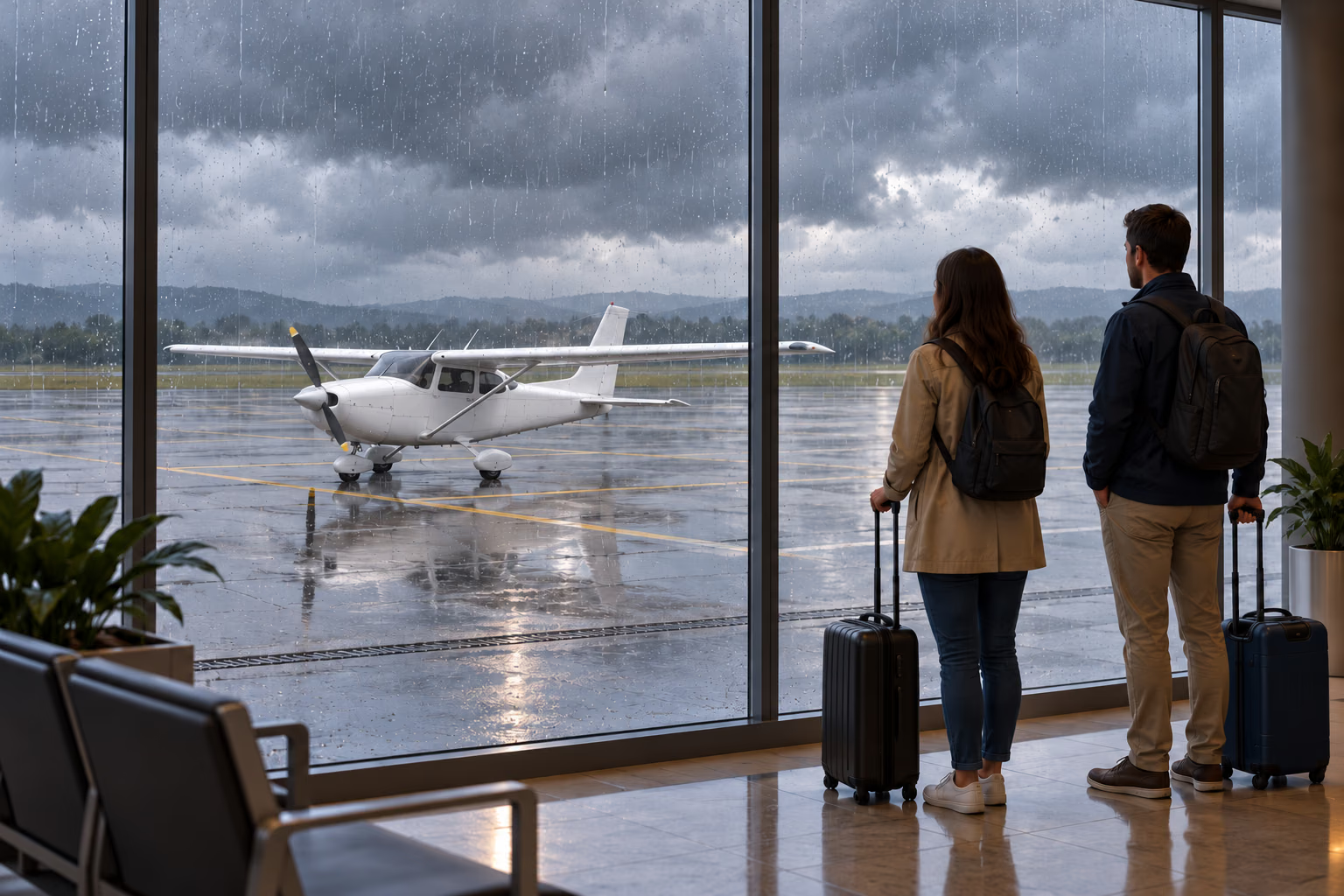
Describe the contrast between the people inside and the aircraft outside. Include the weather you can see, but avoid deciding that a flight has been cancelled simply because the pavement is wet.
Show an example description and teaching notes
Two travellers are standing inside a terminal and looking through a large window. They have suitcases with them. Outside, a small propeller aircraft is parked on wet pavement. Rain is visible on the glass, and dark clouds cover much of the sky. The travellers might be waiting for a flight or watching the aircraft, but their reason for being there is not clear. The conditions look different from the sunny apron scene: the ground is wet and visibility through the window is affected by the rain.
Why this works: the answer moves from inside to outside, uses a comparison and distinguishes observation from speculation. It describes the weather without turning a language exercise into a judgement about whether flying would be permitted.
Try these follow-up questions
- What can you say confidently about the weather, and what can you not determine?
- Compare the mood of this scene with the first illustration. Give a reason for your impression.
- What would you ask the travellers if you wanted to understand their situation?
If you cannot remember “suitcase”, keep the meaning moving: “They each have a bag used for travelling.” Then continue. Describing an object’s purpose is often more useful than stopping to search for one exact word. It is also better than repeatedly using “thing” without explaining what you mean.
Example 3: a light aircraft in a hangar
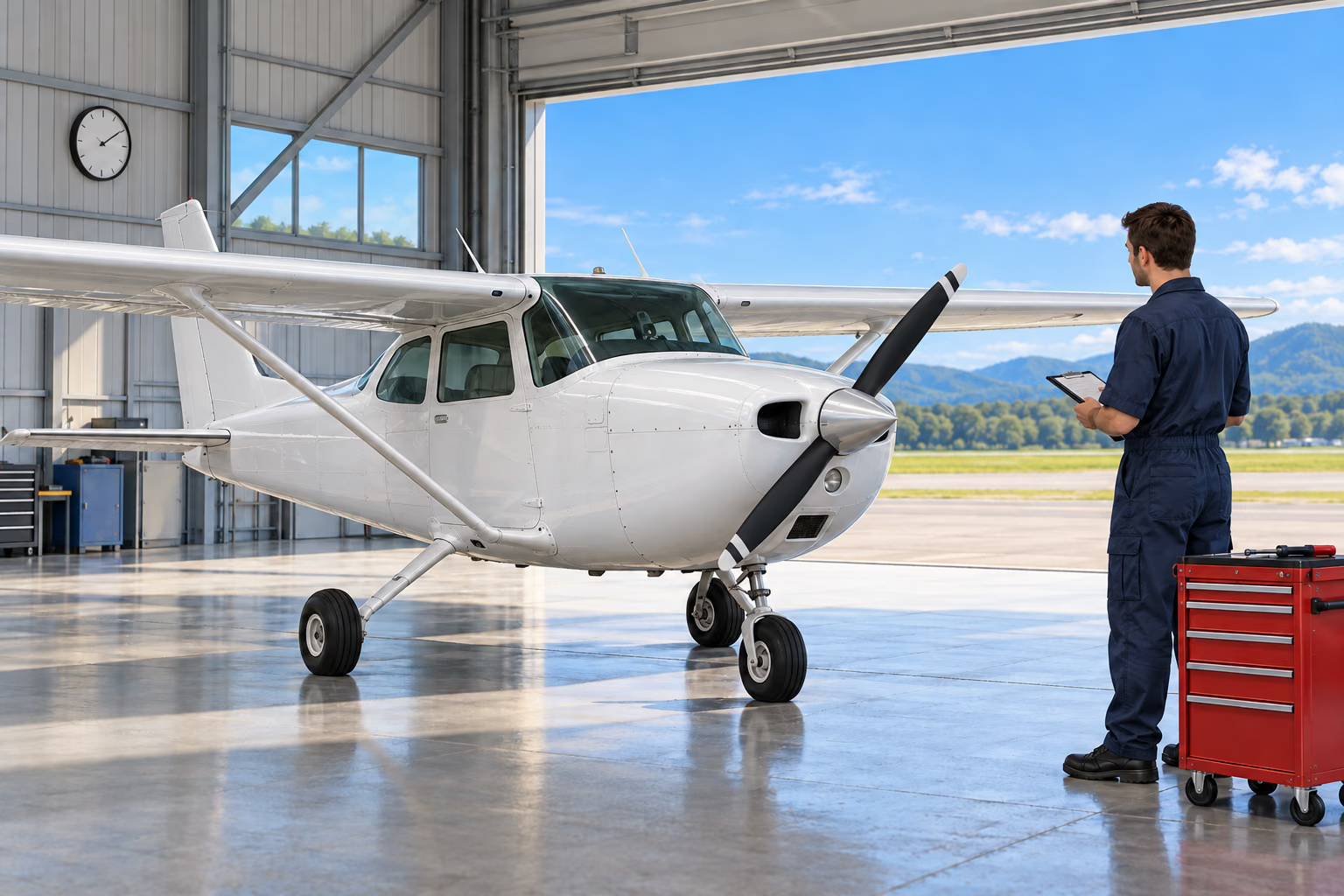
This time, describe the person’s position in relation to the aircraft and toolbox. Think about the difference between “is inspecting” and “may be inspecting”. The image can suggest a role, but it cannot confirm a qualification, defect or completed maintenance check.
Show an example description and teaching notes
A light aircraft is standing inside a hangar with its propeller stopped. A person in dark overalls is holding a clipboard beside a red toolbox. The hangar door is open, and we can see blue sky and green hills outside. The person appears to be checking something or making notes. They may be carrying out an inspection, although no specific problem is visible. I would need more information to know whether the aircraft is being prepared for a flight or is there for another reason.
Why this works: the description links the person, clipboard and toolbox, then recognises the limit of that evidence. It avoids inventing a broken engine or claiming that the aircraft has been declared ready to fly.
Try these follow-up questions
- What suggests that work may be taking place?
- What is similar about this scene and the apron scene? What is different?
- How could you explain “toolbox” if you forgot that word?
Review your answer without guessing a level
- Could a listener identify the main subject without seeing the image?
- Did you connect your details, or only list nouns?
- Did you explain at least one interpretation and mark uncertainty honestly?
- Did you answer the follow-up question that was actually asked?
- If a word was missing, could you express the idea another way?
Choose one change for your next attempt. For example, make the opening clearer or replace an unsupported claim with a cautious explanation. Describe the same image again, then try a different picture so you are practising a skill rather than memorising a paragraph. A written model answer cannot demonstrate pronunciation, listening or live interaction, so it cannot establish an overall ICAO level.
ICAO guidance on language proficiency describes language abilities including paraphrasing and resolving misunderstandings. The aim of these examples is clear, flexible communication, not a script that every candidate should reproduce.
Put the method into practice
Ready for a different image? Open the free ICAO English sample and use its picture prompts without reading these descriptions first. If you can identify a recurring difficulty but cannot work out how to correct it, bring your recording and one specific question to an individual aviation English lesson.
To practise organising information that you hear rather than see, try our worked aviation listening-summary exercise. It uses a separate fictional story and an original recording.
Continue reading
Related articles
Student Pilots
How to Summarise an Aviation Recording: A Worked Listening Exercise
An original one-minute recording with short-note prompts, comprehension checks and a worked summary that keeps the meaning accurate.

Aviation English for Non-Native Speakers: Challenges and Solutions
Aviation English, the internationally recognized language of air communication, is crucial for ensuring safety and smooth operations in the aviation industry. However, for non-native English speakers, achieving proficiency can present certain challenges. In this post, we'll explore some of these obstacles and provide viable solutions to help overcome them.

Elevating Your Aviation English: How Discourse Markers Can Boost Your Exam Performance
For pilots, achieving a high level of proficiency in English is not just a bureaucratic requirement—it’s a critical skill that enhances safety and communication in the skies.