
How to Summarise an Aviation Recording: A Worked Listening Exercise

Understanding an aviation recording involves more than catching isolated words. A useful summary tells a listener what happened, what changed and how the situation ended. This worked listening exercise helps you select those points and express them in your own words, without turning an uncertain detail into a fact.
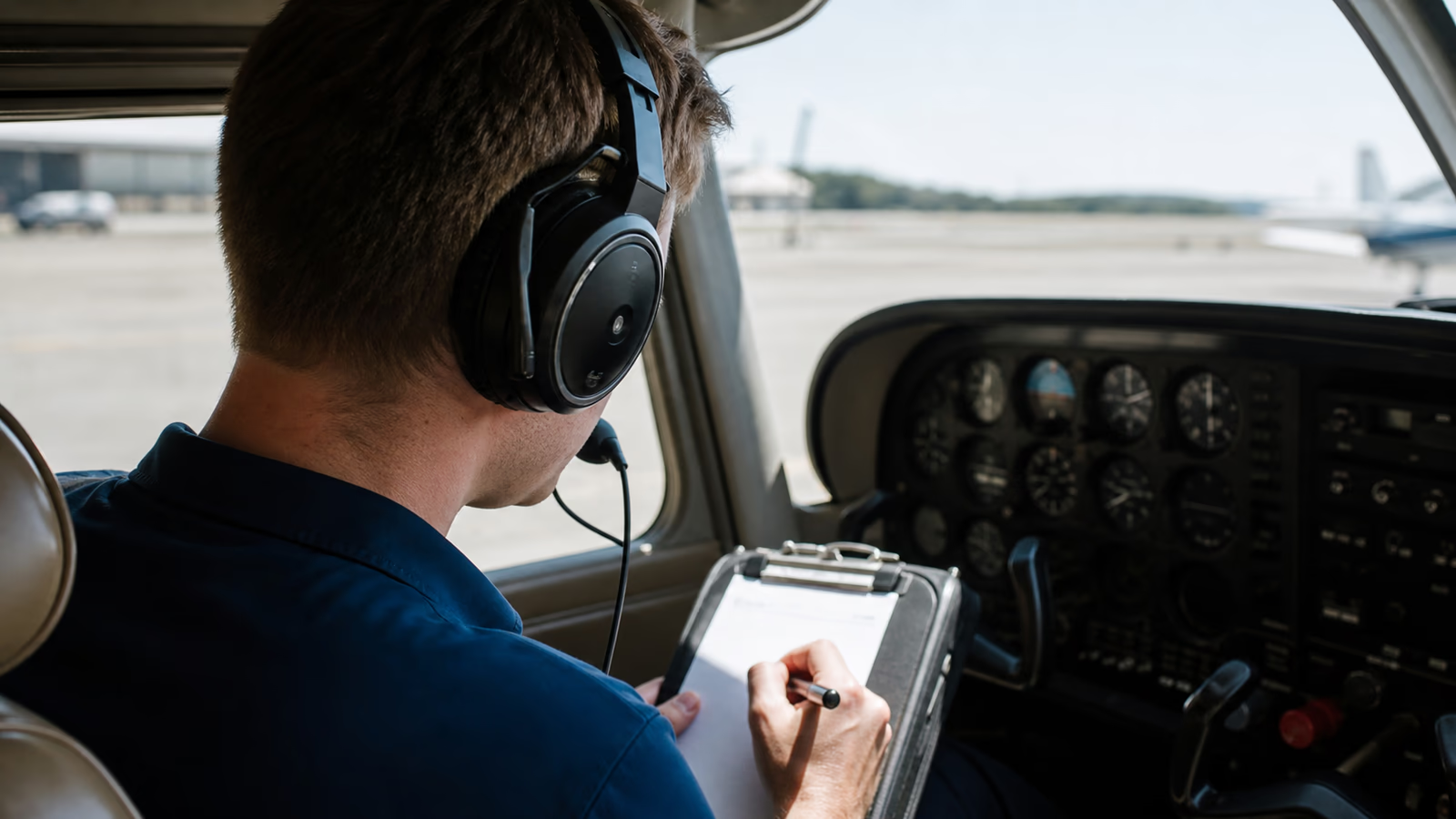
The one-minute recording below is an original fictional training story for listening practice. It is not a real incident, an ATC transmission or an official test item. It practises narrative listening and summarising; it does not replace clearance readback, ATIS training or operational instruction. The illustration above is a separate fictional scene.
Before listening: decide what information matters
You will hear about a planned training flight that did not take place. On the first listen, aim to understand the overall outcome. On the second, collect details that explain it. Two listens are a suggestion for this exercise, not a claim about the rules of any provider’s assessment.
- Plan: what was supposed to happen?
- Changes: what delayed the plan, and in what order?
- Decision: why was the flight eventually cancelled?
- Outcome: what happened instead, and how did the student react?
Listen: a change to a training flight
Download the practice recording (MP3, about 500 KB). Duration: approximately 64 seconds. You can replay it or read the transcript below.
First listen: explain the main point
Without replaying the recording yet, answer in one sentence: what happened to the planned flight, and what did the people do instead? Do not worry about repeating every time or detail. If you only remember a few words, use them to identify which part you need to listen for again.
Second listen: make short notes
Use keywords and arrows rather than writing every sentence. Leave a blank or a question mark if a detail is uncertain. Complete these prompts:
- Planned departure: …
- Initial reason for waiting: …
- Ground-team message: …
- Weather by half past nine: …
- Final reason for cancelling: …
- Alternative activity and student reaction: …
Show one possible set of notes
09:00 planned training flight → cloud base lower than expected → wait for weather update. Delivery vehicle blocks usual parking access → aircraft stays put → vehicle moves after 10 minutes. 09:30 weather better, but instructor has another appointment → not enough time → flight cancelled → ground lesson. No technical defect reported. Student disappointed, but found extra briefing useful.
These notes separate two temporary problems from the final decision. You do not have to use these abbreviations or capture the clock times to give a clear summary.
Check the meaning before reading the transcript
- Was the flight originally planned for nine o’clock or half past nine?
- What did the instructor notice before departure?
- Did the aircraft move while the vehicle was blocking access?
- Was the weather still the stated problem when the flight was cancelled?
- Was a technical defect reported?
- What did the student find useful about the change?
Show answers and the evidence for them
- Nine o’clock. Half past nine is when the story reports improved weather.
- A lower-than-expected cloud base. The instructor and student waited for an updated report.
- No. The recording explicitly says that the aircraft stayed where it was.
- No. The weather had improved; the instructor’s next appointment meant there was insufficient time for the planned flight.
- No technical defect was reported. Do not replace that statement with a claim that every part of the aircraft had been checked and found serviceable.
- The extra briefing. The student said it clarified preparation for the next lesson, despite their disappointment.
Show the complete transcript
On Tuesday morning, a training aircraft was due to leave a small airfield at nine o'clock. Before departure, the instructor noticed that the cloud base was lower than expected. The student had already checked the route, but they decided to wait for an updated weather report. While they were waiting, a member of the ground team told them that a delivery vehicle was blocking access to their usual parking area. The aircraft stayed where it was. The vehicle moved ten minutes later. By half past nine, the weather had improved. However, the instructor's next appointment meant that there was not enough time for the planned flight. They cancelled that flight and used the remaining time for a ground lesson. No technical defect was reported. The student later said that the change was disappointing, but the extra briefing helped clarify how they would prepare for the next lesson.
Build your summary in three parts
- Set the scene: identify the people and original plan.
- Explain the change: include the facts that connect the delay to the final decision.
- Close with the outcome: say what happened instead and mention a relevant reaction.
Put your notes aside and give a 30–45 second spoken summary. That is a study target, not a test time limit. A listener should be able to follow the event without hearing the original. You can leave out a minor detail, but keep the reason for the decision accurate. Do not add an incident or a conversation that the recording never mentions.
Show a worked summary and teaching notes
An instructor and a student planned a morning training flight, but first waited because the cloud base was lower than expected. There was also a temporary problem with a vehicle blocking access to their usual parking area. Although the weather improved, the instructor no longer had enough time before another appointment, so they cancelled the flight and had a ground lesson instead. The student was disappointed but found the additional briefing helpful.
What this preserves: the plan, the initial delay, the later improvement, the final time constraint and the outcome. It shortens “a member of the ground team told them that a delivery vehicle was blocking access” to “a vehicle blocking access”, without changing the essential meaning. “Although” makes the distinction between improving weather and cancellation clear.
Three tempting summaries that change the story
- “They cancelled because of bad weather.” That explains the initial wait, but misses the stated final reason. Add the weather improvement and time constraint.
- “The aircraft had a technical problem.” That detail is not in the recording. A blocked parking area is not an aircraft defect.
- “The lesson was a waste of time.” That replaces the student’s actual reaction with an invented opinion. Their disappointment and the useful briefing can both be true.
A summary does not have to contain every fact. The difference is between leaving out a minor detail and changing the relationship between events. If you are unsure whether you heard a cause or a consequence, listen to the sentence around that detail instead of replaying one isolated word.
Turn your summary into a conversation
- Why did waiting seem reasonable at the start of the story? Base your answer on what was reported.
- How would you explain the final decision to someone who heard only that the weather improved?
- What detail would you ask about if you wanted to understand the student’s next lesson? Make clear that the recording does not supply the answer.
Answer one question, then ask a partner to follow up. Practise checking what they mean if the question is unclear. You are developing comprehension, paraphrasing and interaction, rather than learning a paragraph to repeat. These skills are described in ICAO guidance on language proficiency; a self-check or sample response does not award a proficiency level.
Choose a useful next step
If you missed the main event, repeat this exercise after a break and compare only the key facts. If you understood the story but struggled to explain it, bring your notes and recording to an individual aviation English lesson so the feedback can focus on that specific difficulty.
For different listening tasks, try the free sample’s ATIS and ATC recordings. They practise different information demands and are separate from this story. For an equally practical speaking task, use our three worked picture-description examples.
Continue reading
Related articles

Student Pilots
ICAO Picture Description: Three Worked Examples and Follow-Up Questions
Work through three original aviation scenes, compare your description with teaching examples and practise responding to follow-up questions.
Student Pilots
ATIS Practice for Student Pilots: Listening Exercises and Common Mistakes
Understand ATIS with a worked transcript, answers and three guided listening exercises. Practise notes, details and clear explanations with free audio.
Student Pilots
🛫 How to Decode Fast‑Talking ATC: 5 Steps for Non‑Native Pilots
Understanding rapid ATC transmissions is critical for communication, safety, and ICAO exam success. Here’s a streamlined 5‑step method to help non-native speakers decode fast‑talking controllers and pilots.